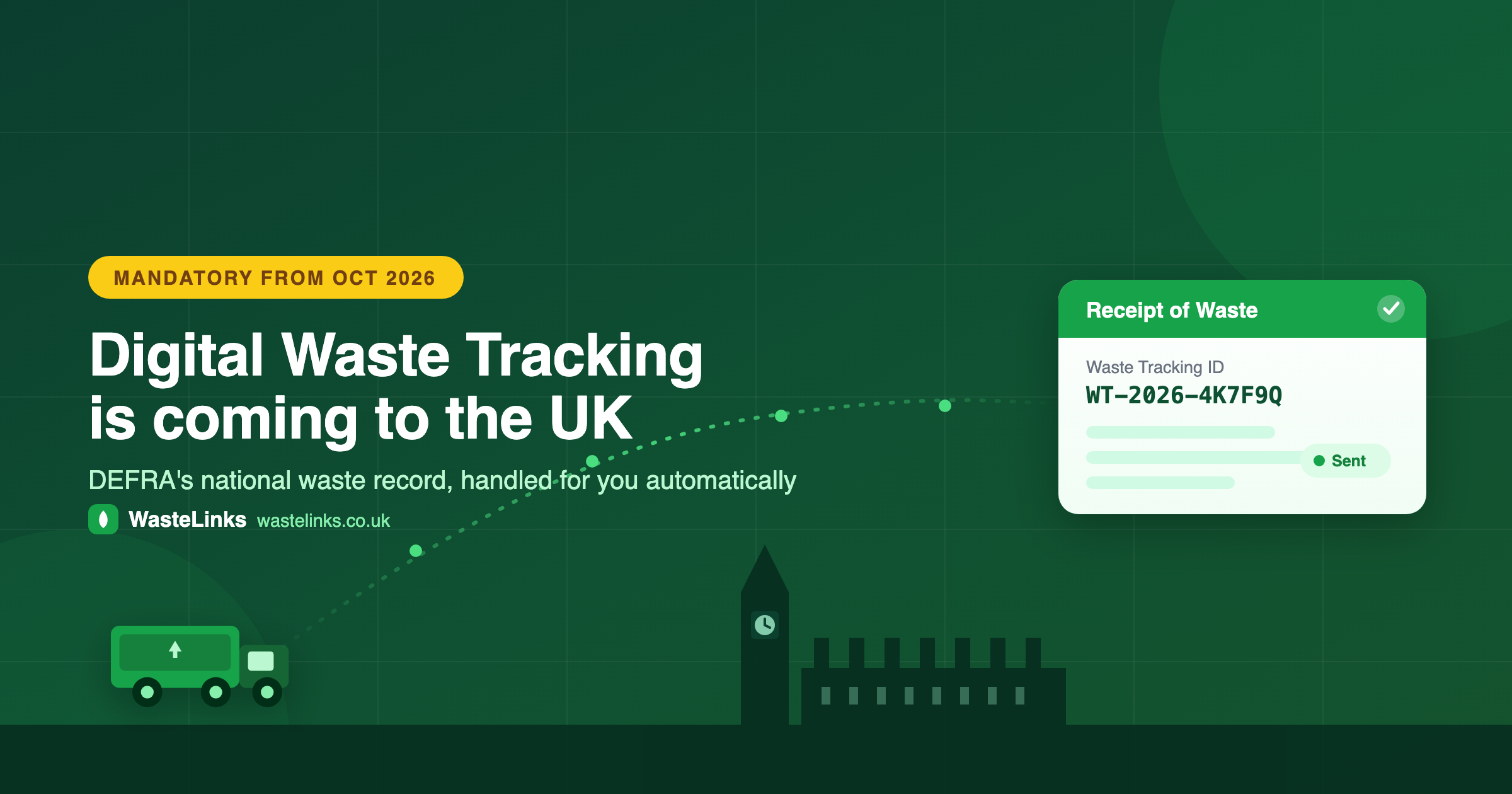
DEFRA's Digital Waste Tracking Arrives in October 2026: How WasteLinks Will Handle It for You
From October 2026 every UK waste movement must be reported to DEFRA's Digital Waste Tracking service. Here is how WasteLinks will submit yours automatically.
From October 2026, every waste movement in the UK will need to be recorded digitally with the government. It is the biggest change to waste regulation in a generation, and it is called Digital Waste Tracking, or DWT for short. DEFRA has been building the service for several years, and the final piece fell into place this spring when the system opened its public beta and confirmed the go live date.
We know a change like this can sound like more admin, more forms and more things to get wrong. So we want to be clear about our position from the start. WasteLinks is being built so that Digital Waste Tracking happens automatically in the background of every collection booked through the platform. If you are a carrier working with us, or a customer booking through us, the new rules should cost you nothing in extra effort.
Here is what is changing, where we are with our integration, and exactly how it will work once DEFRA issues our access credentials.
What is Digital Waste Tracking?
Today, the record of a waste movement lives on a waste transfer note. It might be paper in a cab, a PDF in an inbox, or a line in a spreadsheet. There is no single national picture of where waste actually goes, which is part of the reason waste crime costs the UK economy around a billion pounds every year.
Digital Waste Tracking replaces that patchwork with one central government record. When waste arrives at a receiving site, a digital Receipt of Waste is submitted to DEFRA's system. In return, the movement is issued a unique Waste Tracking ID, a permanent reference that regulators, carriers and producers can all point to. The Environment Agency and its counterparts in Wales, Scotland and Northern Ireland will use these records to see the full journey of the nation's waste.
From October 2026 this stops being optional. Submitting these records will be a legal requirement for waste received in the UK.
Where WasteLinks is right now
We did not want to wait until autumn to start this work, so we have already built our submission engine and connected it to everything else the platform knows about a job.
WasteLinks already captures most of what a Receipt of Waste needs as part of a normal booking. Every collection carries its European Waste Catalogue code, which you can explore in our waste codes library, along with the weight recorded by the driver, the waste description, the hazardous classification and the carrier's Environment Agency registration, which we verify when a carrier joins the platform. This year we added the remaining fields DEFRA asks for, including disposal and recovery codes, the physical form of the waste and details of the receiving facility.
The final step is credentials. DEFRA runs a formal onboarding process for software providers, and we are in it. Once their team issues our API access, we will connect to their integration environment and run the full set of acceptance tests DEFRA requires, covering everything from a simple household collection to hazardous movements with consignment notes. Only after DEFRA reviews and approves those test results does a provider receive production access. We see that rigour as a good thing. It means that by the time the feature switches on for real movements, it will have been tested against every scenario the regulator could think of.
How a submission will actually work
Picture a normal job on WasteLinks. A customer books a collection, a driver arrives, loads the waste, records the weight, takes photos and captures a signature. The moment that job is completed, our system quietly assembles the Receipt of Waste from the data the job already contains and sends it to DEFRA.
Seconds later, DEFRA's system responds with the Waste Tracking ID. We attach that ID to the job permanently, alongside the digital waste transfer note we already generate, so a carrier can open their compliance records and see the government reference sitting next to the signature, the photos and the weighbridge figure. One collection, one complete evidence trail.
The important part is what happens when something goes wrong. If DEFRA's service is briefly unavailable, or a submission needs a correction, nothing stops on site. The driver finishes the job, the customer gets their paperwork, and our system keeps retrying the submission in the background until it succeeds. Every attempt is logged, so there is always an honest audit trail showing what was sent and when. A collection will never be held hostage by a server.
What this means for carriers on WasteLinks
Very little, and that is the point. Carriers who keep their WasteLinks profile up to date, with their disposal facilities, waste codes and licence details current, will find that Digital Waste Tracking simply starts happening for their completed jobs. There is no new form to fill in and no separate government portal to log into after every collection.
There will be one piece of housekeeping. DEFRA requires waste operators to register for the service, and as the deadline approaches we will walk every carrier on the platform through that step and connect their registration to their WasteLinks account. We will share dates and instructions well ahead of October, and our team will be on hand through our contact page for anyone who wants help.
For customers, the benefit is straightforward. When you book through our marketplace, your duty of care evidence gets stronger. You will be able to show not just a transfer note, but a government issued tracking ID proving your waste was received and recorded properly.
Frequently Asked Questions
When does Digital Waste Tracking become mandatory?
DEFRA has confirmed that digital waste records become mandatory in October 2026. The service is in public beta now, and software providers like WasteLinks are integrating ahead of the deadline so carriers can be ready early.
Do I need to submit records myself if I use WasteLinks?
No. Once our DEFRA integration is live, WasteLinks builds and submits the Receipt of Waste automatically when a job is completed, then stores the returned Waste Tracking ID against the job. You keep your registration details up to date and we handle the rest.
What happens if a submission fails?
The collection carries on as normal. Our system retries failed submissions automatically and keeps a log of every attempt, so there is a full audit trail and no gap in your compliance records.
Will the Waste Tracking ID replace my waste transfer note?
During the transition we will keep issuing our digital waste transfer notes exactly as we do today, with the Waste Tracking ID stored alongside them. As DEFRA finalises guidance on which documents remain required, we will adjust so you always hold whatever the law expects.
What should I do to prepare before October 2026?
Make sure your WasteLinks profile is complete, especially your disposal facilities, EWC codes and licence details. When DEFRA registration opens up for operators, we will contact every carrier on the platform with simple instructions for linking their registration.
We will publish updates here on the blog as our integration passes DEFRA's tests and goes live. In the meantime, if you are a carrier who wants to be ahead of the October deadline, the best first step is to list your business on WasteLinks and let the platform carry the compliance weight for you.
Ready to get started with WasteLinks?
Find verified waste carriers or list your services today.